i
Session 3 :: Form(s) of intelligence DDH ()


Session 3 :: Form(s) of intelligence


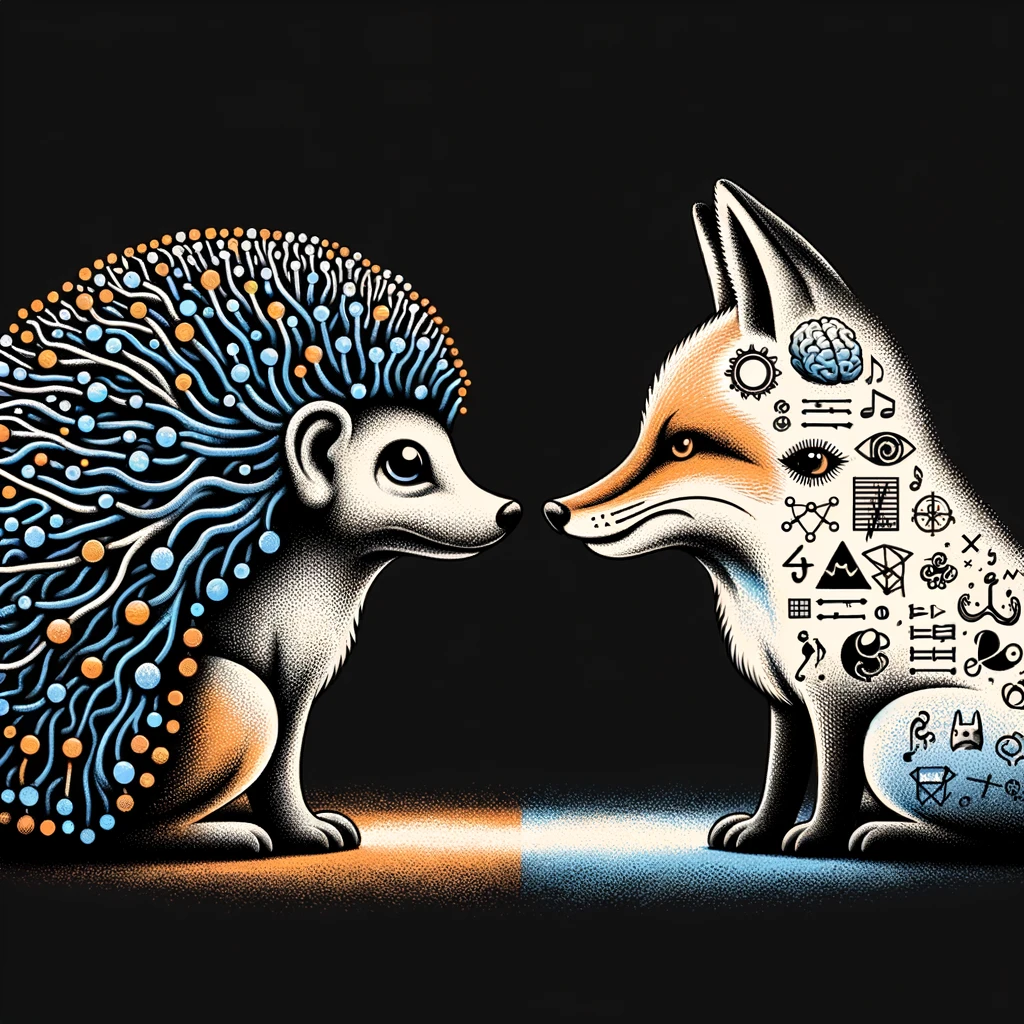
Hedgehogs and foxes

πόλλ' οἶδ' ἀλώπηξ, ἀλλ' ἐχῖνος ἓν μέγα

Multa novit vulpes, verum echinus unum magnum

"a fox knows many things, but a hedgehog knows one big thing"

The Cat & The Fox

Once a Cat and a Fox were traveling together. As they went along, picking up provisions on the way—a stray mouse here, a fat chicken there—they began an argument to while away the time between bites. And, as usually happens when comrades argue, the talk began to get personal.

"You think you are extremely clever, don't you?" said the Fox. "Do you pretend to know more than I? Why, I know a whole sackful of tricks!"

"Well," retorted the Cat, "I admit I know one trick only, but that one, let me tell you, is worth a thousand of yours!"

Just then, close by, they heard a hunter's horn and the yelping of a pack of hounds. In an instant the Cat was up a tree, hiding among the leaves.

"This is my trick," he called to the Fox. "Now let me see what yours are worth."

But the Fox had so many plans for escape he could not decide which one to try first. He dodged here and there with the hounds at his heels. He doubled on his tracks, he ran at top speed, he entered a dozen burrows,—but all in vain. The hounds caught him, and soon put an end to the boaster and all his tricks.


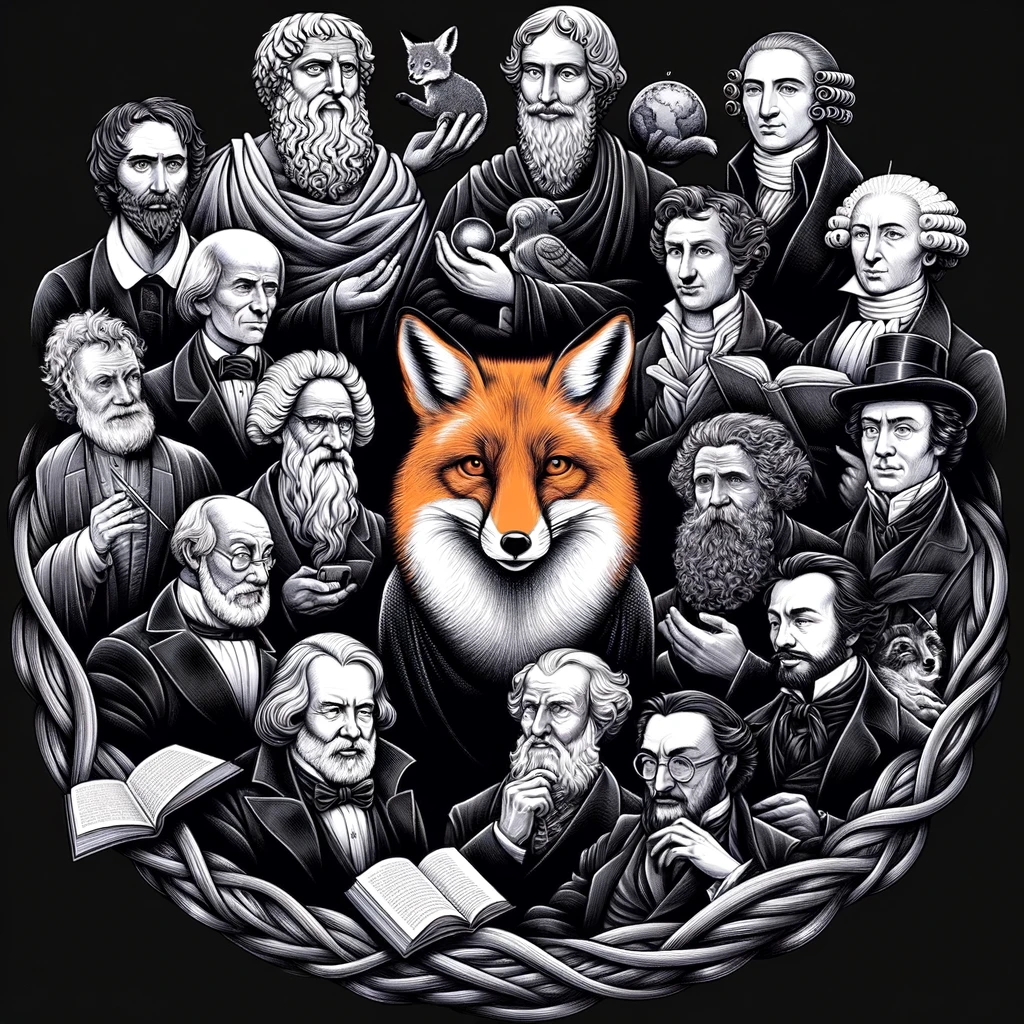
Foxes

Foxes draw on a wide variety of experiences. For foxes, the world cannot be boiled down to a single idea.

Berlin's examples from literature and philosophy: Herodotus, Aristotle, Desiderius Erasmus, William Shakespeare, Michel de Montaigne, Molière, Johann Wolfgang Goethe, Aleksandr Pushkin, Honoré de Balzac, James Joyce etc.

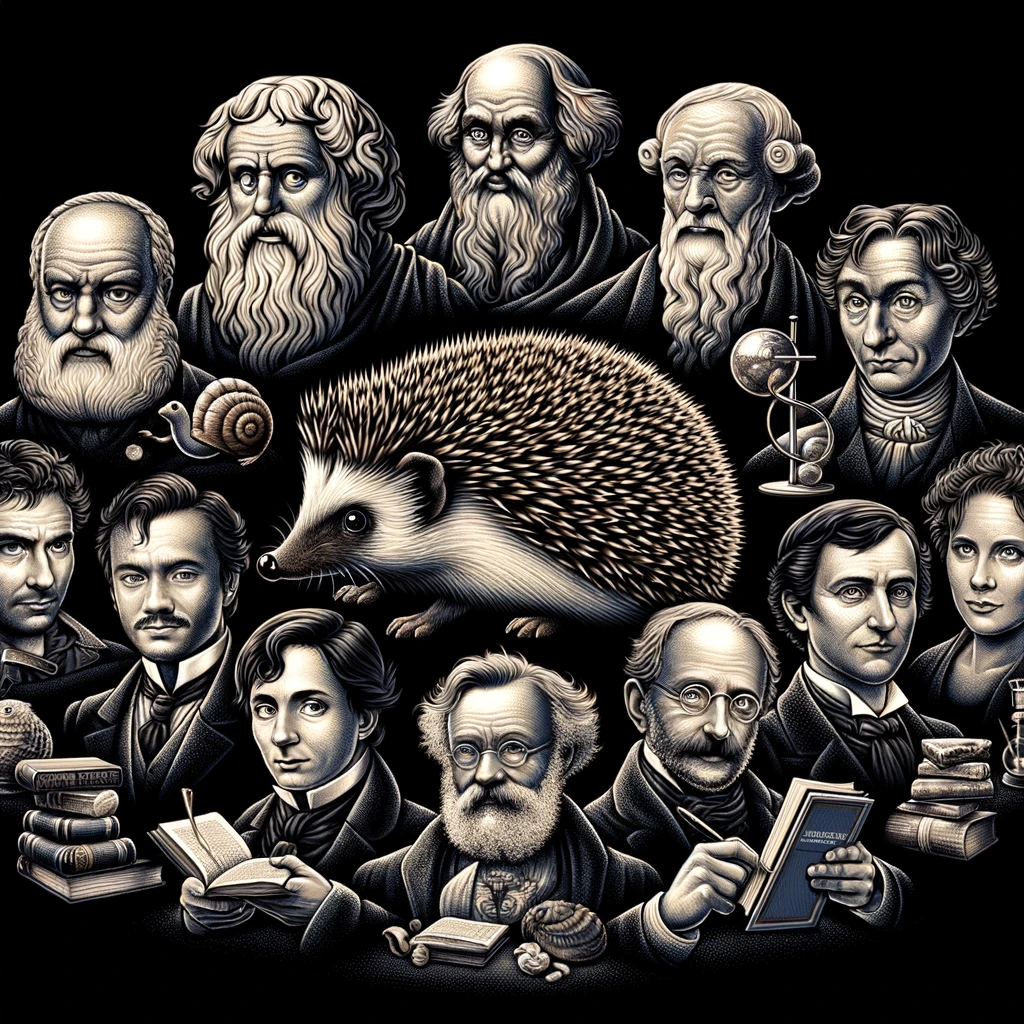
Hedgehogs

Hedgehogs view the world through the lens of a single defining idea.

Isaiah Berlin gives following examples in domains of art and philosophy: Plato, Lucretius, Dante Alighieri, Blaise Pascal, Georg Wilhelm Friedrich Hegel, Fyodor Dostoyevsky, Friedrich Nietzsche, Henrik Ibsen, Marcel Proust and Fernand Braudel.

Questio

Are You a hedgehog or a fox ?

General Intelligence

Generic intelligence refers to the overall, broad cognitive ability that an individual possesses. It's a general concept that encompasses a range of cognitive skills, including memory, reasoning, problem-solving, and learning. In an educational context for undergraduates, think of generic intelligence as the foundational mental capacity that enables you to adapt to new situations, solve diverse problems, and acquire knowledge in various domains. It's not limited to academic learning but also includes practical problem-solving and everyday reasoning. This concept suggests that some aspects of intelligence are universal and not specific to a particular skill or area of knowledge.

Spearman's Universal Unity of the Intellective Function

Whenever branches of intellectual activity are at all dissimilar, then their correlations with one another appear wholly due to their being all variously saturated with some common fundamental Function (orgroup of Functions).

(Spearman, 1904, p.273 in "General Intelligence: Objectively determined and measured")

Intelligence Quotient

IQ, or Intelligence Quotient, is a numerical measure of a person's cognitive abilities relative to their age group. By evaluating a range of cognitive skills, so-called "IQ tests" attempt to quantify the g factor, providing a score that reflects an individual's overall intellectual ability.  An average IQ score is set at 100, with the majority of people scoring within a range around this center point. IQ tests aim to quantify cognitive capability and potential, providing a standardized way to evaluate intellectual abilities across different individuals.

G Factor

The 'g factor,' or general intelligence factor, is a theoretical construct proposed by psychologist Charles Spearman. It suggests that a single, underlying intelligence influences an individual's performance across various cognitive tasks. In simpler terms, if you're good at one intellectual task, you're likely to be good at others because of this general intelligence. For undergraduates, this concept implies that some people have a higher overall cognitive ability that contributes to their performance in different academic and intellectual areas. It's a controversial yet influential idea in psychology, as it argues for a single, quantifiable measure of intelligence rather than multiple, distinct abilities.

A little IQ test maybe ?

This is an IQ test loosely modeled after Raven's Progressive Matrices. The questions take the form of a 3x3 matrix from which one tile is missing. For each question there are eight possible answers A-H. You must choose the tile that completes that matrix best.

Take Your time. When done earlier than Your colleagues, feel free to take a break.

Theory of Multiple Intelligences

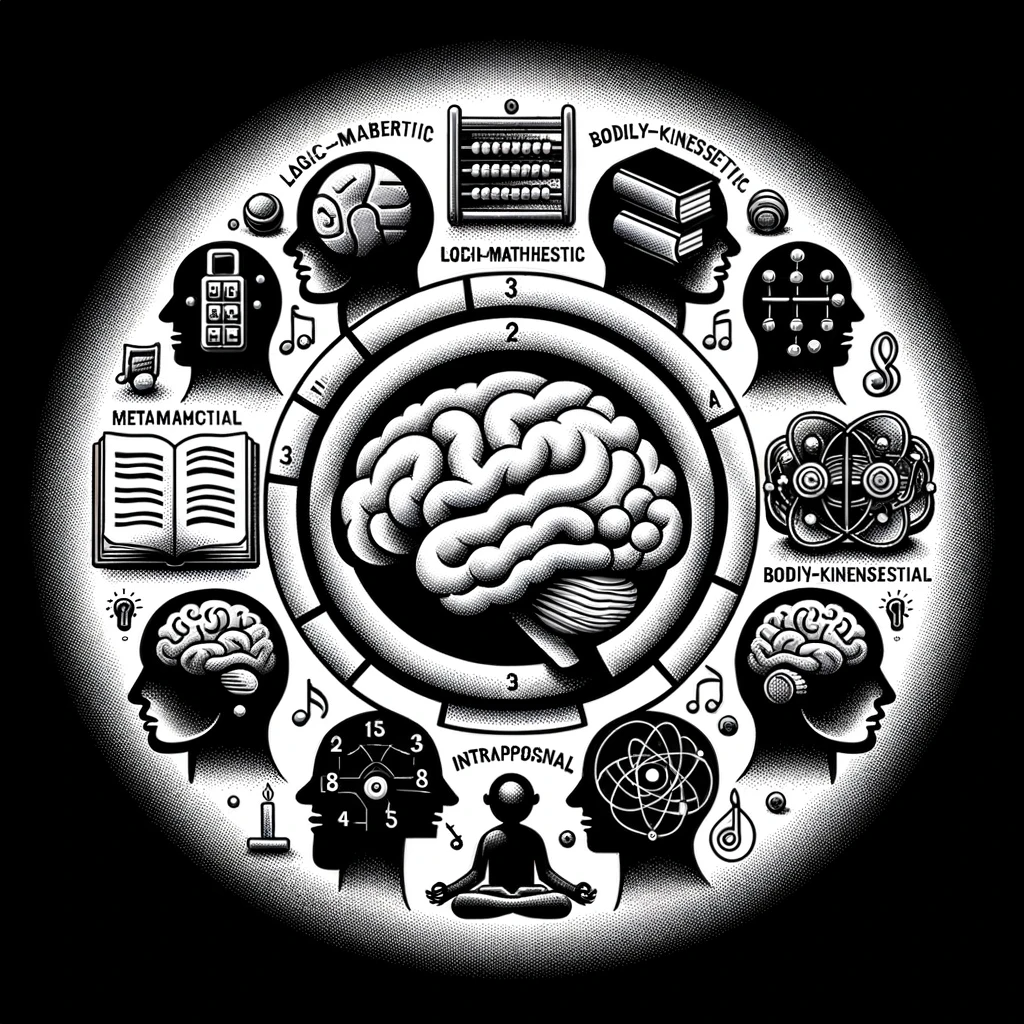
Contrasting traditional views that focus on a single, general intelligence, Theory of Multiple Intelligences proposed by Howard Gardner in 1983 posits that humans possess a variety of distinct intelligences. These include linguistic, logical-mathematical, spatial, musical, bodily-kinesthetic, interpersonal, intrapersonal, and naturalistic intelligences. Each intelligence represents a different way of processing information and solving problems, challenging the notion of intelligence as a singular, measurable trait. This theory emphasizes the unique cognitive strengths individuals have and suggests a more personalized approach to education and learning.

Linguistic Intelligence

The ability to master language and communicate effectively. People with high linguistic intelligence are adept at reading, writing, telling stories, and memorizing words. They tend to learn best by reading, taking notes, and discussing.

Defining criteria of an intelligence

Gardner identifies several key criteria that a cognitive ability must meet to be considered an intelligence:

Potential Isolation by Brain Damage

Existence of Savants, Prodigies, and Other Exceptional Individuals

An Identifiable Core Operation or Set of Operations

A Distinct Developmental Trajectory

An Evolutionary History and Evolutionary Plausibility

Support from Experimental Psychological Tasks

Support from Psychometric Findings

Susceptibility to Encoding in a Symbol System

Musical Intelligence

The capacity to discern pitch, rhythm, timbre, and tone. This intelligence enables people to recognize, create, reproduce, and reflect on music.

Logical-Mathematical Intelligence

Involves the capacity to analyze problems logically, carry out mathematical operations, and investigate issues scientifically. It's characterized by strong reasoning, recognizing patterns, and logically analyzing problems.

Visual-Spatial Intelligence

Involves the potential to recognize and use patterns of wide space and more confined areas. It's often found in architects, artists, and navigators.

Bodily-Kinaesthetic Intelligence

Entails using one's body effectively, such as dancers or surgeons. It involves a sense of timing, clear physical coordination, and using fine and gross motor skills.

Personal Intelligences

Personal Intelligences

Hausaufgabe

in #edu-intelligence room, put an emoticon of Your choice under intelligence X of Your choice

take note of who else is in Your group

read the chapter in Gardner's Frames of Mind

read additional literature

every group should present X in any way You find appropriate (be creative!)

topics which should be adressed in the presentation: Gardner's 8 criteria respective to X; examples of persons who exemplified high (or low) degree of X; relations of X to other inteligences

two most important questions: How would You evaluate X of human subjects ? How would You evaluate X of a machine ?